
Panic attack as a highly sensitive person? Learn the symptoms, how long it lasts, and the ice water trick plus breathing techniques that calmed mine fast.
A panic attack as a highly sensitive person often begins in your mind, with a spiral of what-ifs, before your body joins in with a racing heart, a tight chest, tears and a strong urge to flee. Most panic attacks peak within about 10 minutes and pass within 5 to 20 minutes. The quickest way out is to calm your body first: briefly dip your face in ice-cold water (if you don’t have a heart condition), then slow your breathing with 4-7-8 or box breathing.
I’m writing this 20 minutes after a panic attack
Yes, really. About 20 minutes ago, I was in a full-blown panic attack. Now I’m writing this blog. Why?
Because I wasn’t aware how powerful the technique I used today was, and I want you to have it too. If you feel a panic attack coming on while you’re reading this, scroll straight down to step 3, the ice water reset. Everything else can wait.
Panic attacks are not new to me. When I first started healing some of my past traumas, I went through episodes of them. Back then, I didn’t have the right tools. An attack could last 20 minutes, and it got so intense that I felt a tingling sensation in my head and eventually through my entire body.
Thankfully, they’ve become rare over the past years. Today, however, one caught me completely off guard. And in that moment, I remembered exactly why I started HiSensitives: I never want anyone to feel as lost in a panic attack as I once did.
Why are highly sensitive people more prone to panic attacks?
As highly sensitive people, we tend to be more anxious than others, and our nervous system goes into overdrive more easily. Sometimes that overdrive tips over into a panic attack.
Research backs this up. Sensory processing sensitivity, the scientific name for high sensitivity, is found in roughly 20% of people (Acevedo et al., 2014). A 2025 study of 562 university students linked higher sensitivity to more worrying, rumination and social anxiety (Behavioral Psychology, 2025). Furthermore, a 2024 systematic review found a consistent link between high sensitivity and stress (Harrold et al., 2024).
Here’s the hopeful part. In one study described by HSP researcher Dr. Elaine Aron, highly sensitive people who scored high in mindfulness and acceptance were not particularly anxious (Psychology Today). In other words, your sensitivity is not a life sentence of panic. With the right tools, it becomes something you can work with.
What triggered my panic attack today?
For the past few months, I’ve had a bigger workload than usual. As a freelancer in online marketing, I also feel the AI movement changing my field at a rapid pace, and I’m adapting a lot of things in my business.
I’m usually a very positive person, and I genuinely feel good about the changes I’m making. My highly sensitive nervous system, however, responds very poorly to them. We humans crave security and control. We want to know what’s coming. When everything changes this fast, and nobody knows what it will mean for humanity in the long run, it’s really hard to keep your brain calm.
Consequently, my brain had been running in overdrive for months. Then, this morning, I read another article about another round of layoffs. Around me, I kept hearing about people being replaced with AI in companies. And it hit me: this really feels like humans are being replaced by a machine. That was the final straw for my nervous system.
What does a panic attack feel like for a highly sensitive person?
For me, it unfolded in a chain reaction, each step feeding the next:
- The overthinking. My mind started going: what if this happens? And what if that happens? I made up one worst-case scenario after another, which is so very HSP.
- A racing heart. My body reacted to all those thoughts as if they were real danger.
- Tears. My emotions joined in and my eyes got teary. Then I asked myself why I was getting so upset, and that question pulled me even deeper into the spiral.
- Brain fog. My head felt foggy and I couldn’t focus anymore.
- The urge to flee. My first impulse was to cancel my workday and book a wellness treatment. I didn’t, because running away doesn’t solve anything.
- A tight chest. Through all of it, my chest felt tight.
Sound familiar?
What are common physical symptoms of a panic attack?
The most common physical symptoms of a panic attack are a racing heart, shortness of breath, a tight chest, trembling, sweating, dizziness and tingling. According to NHS inform, you may experience:
- A racing or irregular heartbeat (palpitations)
- Shortness of breath or a choking sensation
- Chest pain or tightness
- Trembling, shaking or shivering
- Sweating, hot flushes or chills
- Dizziness or feeling faint
- Nausea or a churning stomach
- Numbness, pins and needles or tingling fingers
- A dry mouth or ringing in your ears
- A feeling of dread or a fear of dying
As an HSP, you might also notice symptoms that rarely make the official lists: tears, brain fog, and a sudden need to leave the room or cancel your whole day.
Panic attacks feel frightening, yet they don’t cause physical harm (NHS inform). Still, chest pain deserves respect. Panic-related chest pain usually stays in the middle of the chest, while heart attack pain often spreads towards the left arm or jaw (WebMD). If it’s your first time or you’re unsure, call your doctor. Better safe than sorry, right?
How long do panic attacks typically last?
Most panic attacks last 5 to 20 minutes, and symptoms usually peak within about 10 minutes (Cleveland Clinic; WebMD). Some can last up to an hour, but that usually means one attack followed another, or high anxiety lingered afterwards (NHS inform). Afterwards, many people feel exhausted for hours.
My own experience shows how much tools matter. Back when I was working through my trauma, a panic attack could last me 20 minutes. Today, it took about 5 minutes before I realized my first technique wasn’t working and grabbed the ice water. After that, I calmed down almost immediately.
How to stop a panic attack: my HSP toolkit
To stop a panic attack, calm your body before you try to calm your thoughts. These are the five steps that work for me, in the order I use them.
1. Remind yourself: it’s just your brain
In that moment, it feels like your entire life is falling apart. It isn’t. It’s your brain and your vagus nerve being overstimulated and stuck in fight-or-flight mode. Your only job right now is to get out of that mode.
Naming it helps. Cleveland Clinic also recommends acknowledging that you’re having a panic attack, not a dangerous health event, and reminding yourself that it will pass (Cleveland Clinic).
2. Don’t force meditation (yet)
Many people will tell you to meditate when you’re panicking. Today, my first move was a tension release meditation. However, it didn’t work. My brain was in such overdrive that I simply could not relax or focus on the meditation.
So if meditation doesn’t help you mid-panic, there’s nothing wrong with you. Your system first needs something stronger to snap out of it.
3. The ice water reset
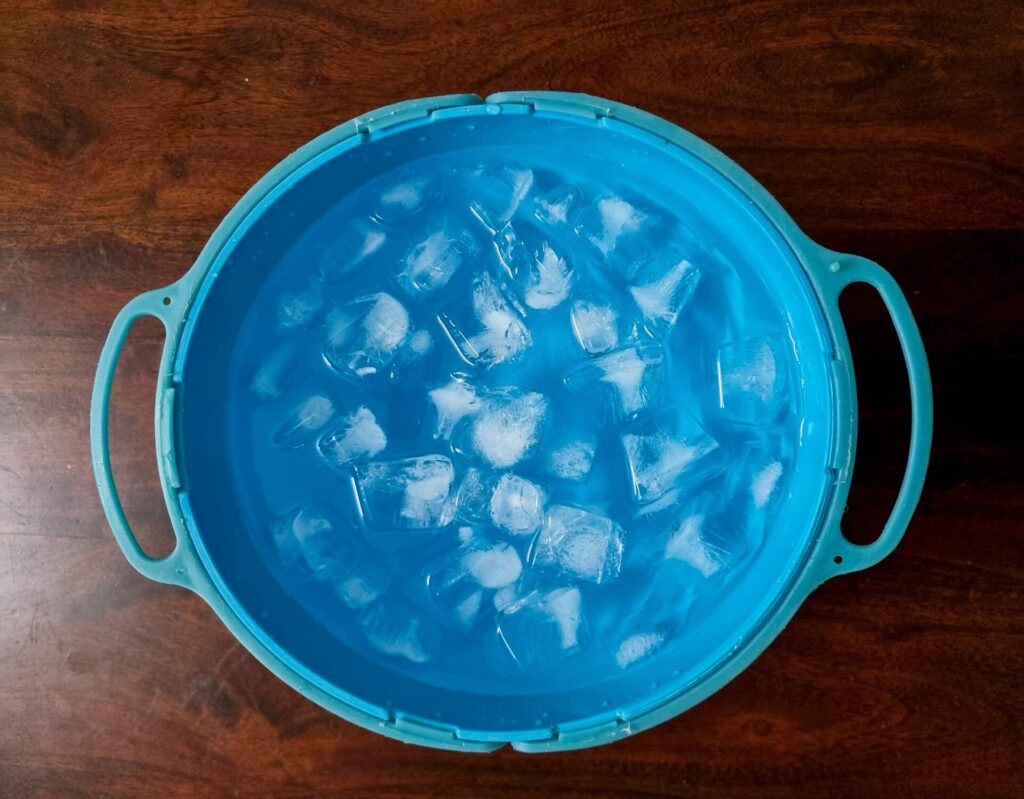
This is the tool that changed everything for me today. I grabbed a bowl of water, added some ice and dipped my face in it.
It sounds silly, right? I felt a bit silly doing it, too. But immediately, my brain snapped out of fight-or-flight mode and my entire system calmed down. I went from “this whole day is over, I need to call it a mental health day” to “wow, I feel calm, I have to share this with you” in minutes.
Why does it work? Cold water on your face triggers the mammalian dive reflex. Nerve receptors around your eyes, forehead and nose send a signal to your vagus nerve, which slows down your heart rate (Psychology Today). Submerging your face slows the heart more than cooling other body parts, and the facial receptors respond most strongly to water of about 10 to 15°C (diving response study, 2021).
How to do it:
- Fill a bowl with cold water and add a handful of ice cubes.
- Take a breath in and hold it.
- Dip your face in so the water covers your forehead, eyes and upper cheeks.
- Stay there for 10 to 15 seconds, then come up and breathe. Repeat once or twice if you need to.
No bowl nearby? Hold an ice pack or a bag of frozen peas against your eyes and cheeks, or splash ice-cold water on your face (Grounded Roots Mental Health Therapy).
A safety disclaimer: this technique deliberately slows your heart rate. If you have a heart condition, a naturally slow heart rate or any other medical concerns, check with your doctor before trying it.
4. Breathe slowly with box breathing or 4-7-8
After the ice water, your body is much more receptive to breathing techniques and meditation. Slow, controlled breathing activates your parasympathetic nervous system, which helps you shift back towards calm (Cleveland Clinic).
Box breathing:
- Breathe in for 4 counts.
- Hold for 4 counts.
- Breathe out for 4 counts.
- Hold for 4 counts, then repeat a few rounds.
4-7-8 breathing:
- Breathe in through your nose for 4 counts.
- Hold your breath for 7 counts.
- Breathe out slowly through your mouth for 8 counts.
- Repeat for 3 to 4 rounds.
My tip: practice these when you’re calm, not only in an emergency. Integrative medicine specialist Dr. Melissa Young suggests three cycles of 4-7-8 breathing twice a day to make it a habit (Cleveland Clinic). That way, your body already knows what to do when panic shows up.
5. Do a brain dump afterwards
Once you feel calmer, don’t keep all those thoughts swirling in your head. Grab a notebook and write everything down, staying calm and grounded while you do it.
Then highlight one or two things you can focus on over the next few weeks to take steps towards solving the situation. Just one or two. You don’t have to fix the whole world today.
When should you get extra support?
I learned to cope with panic attacks through therapy and a lot of trying things out. And my husband was, and still is, my rock to lean on. You don’t have to figure this out alone either.
Talk to your doctor or a mental health professional if:
- Panic attacks keep coming back unexpectedly
- You’ve spent a month or more worrying about the next one, or avoiding places because of it (NIMH)
- Your symptoms last longer than 15 minutes (Cleveland Clinic)
- You have chest pain and aren’t sure it’s panic (call emergency services right away)
This blog shares my personal experience and is not a replacement for medical advice.
How can you build a calmer, more resilient brain?
Ice water and breathing are your emergency tools. Long term, however, it pays off to train your brain to be more resilient, so panic has less fuel to begin with.
That’s exactly why we created Mental Detox together with hypnotherapist Ashley Bentley. It’s a one-hour masterclass on how to work with your brain instead of against it, including how to boost your happiness chemicals and a wonderful yoga nidra experience to help you relax deeply. You also get an e-book that dives into the science behind your brain, plus five worksheets to help you work with your nervous system.
The whole toolkit is only €9.99, which makes it a real steal. All the tools inside it helped me, too, and I hope they help you just as much.
If you’re spiraling right now, read this
You do not have to solve all the problems of the world right now. Right now, your only focus is to calm your body.
Grab the ice water (if you don’t have a heart condition). Breathe. Then, once you feel a little more grounded, do your brain dump and pick one or two small steps for the coming weeks.
Even if you’re a more anxious person, you can be resilient. You can stay strong when you’re overthinking and when you’re sensitive. You. can. get. through. this.
Frequently asked questions about panic attacks in highly sensitive people
A panic attack can feel like a heart attack or even like dying, but it doesn’t cause physical harm (NHS inform). If you’re unsure what’s happening, especially with chest pain, always get medical help.
Highly sensitive people have strong emotional reactivity, so tears often join in when your heart starts racing. In my experience, crying is part of the spiral, not a sign that you’re weak. Accept the tears and focus on calming your body.
An anxiety attack usually builds up gradually around a specific stressor and feels less intense but lasts longer. A panic attack comes on suddenly, with very intense but brief symptoms (Cleveland Clinic). For HSPs, the two can overlap: my stress built up for months, yet the panic attack itself arrived out of nowhere.
The dive reflex is a natural reflex in all mammals, yet everyone’s body responds a little differently. Research on using it for panic is still young. Try it once on a calm day, so you know what it feels like before you need it.
Not always, but you can make them less likely and shorter. Practice slow breathing daily, notice your early signs (for me, the what-if spiral), limit overstimulation such as endless news scrolling, and build mindfulness and acceptance into your routine.
You May Also Enjoy Reading These Articles

In this article, we collaborated with AI, meaning that the input and stories are original human ideas, but the text itself has been created with support from AI. All AI content is being edited and factchecked by our editor.